[back] C/2025 R3 (PanSTARRS)

Bigger version / Größere Version (4744 x 3104 pixel)
Anotated version / Beschriftete Version
Animated version / Animierte Version
 (c) 2026 All astro photo images are copyrighted. They may not be used or reproduced without explicit written permission from the authors.


300"


About this Images / Über dieses Bilder


Camera: Moravian C3-PRO-61000 Mono CMOS
Image Type, Orientation: L-RGB composite,  North is at 12:00
Exposure time/date: May 10th 2026 (17:26-18:29 UT)
L: 60 x 15s, RGB: 20/20/20 x 15s (0:30h total)
Location: Capella Observatory South at Kiripotib Astro Farm, Namibia
Filter of upper image: Astronomik Deep-Sky Deep-Sky RGB Filter  plus 6nm SII, Ha, OIII filters on Moravian EFW-3L-9-II External Filter Wheel
Instrument: "Rhea", a PlaneWave DeltaRho 350, 1050mm focal length, 350mm aperture,  f/3 on 10Micron GM2000 HPS II Combi
Photographer: Rainer Raupach, Josef Pöpsel, Stefan Binnewies, Frank Sackenheim

Remarks:

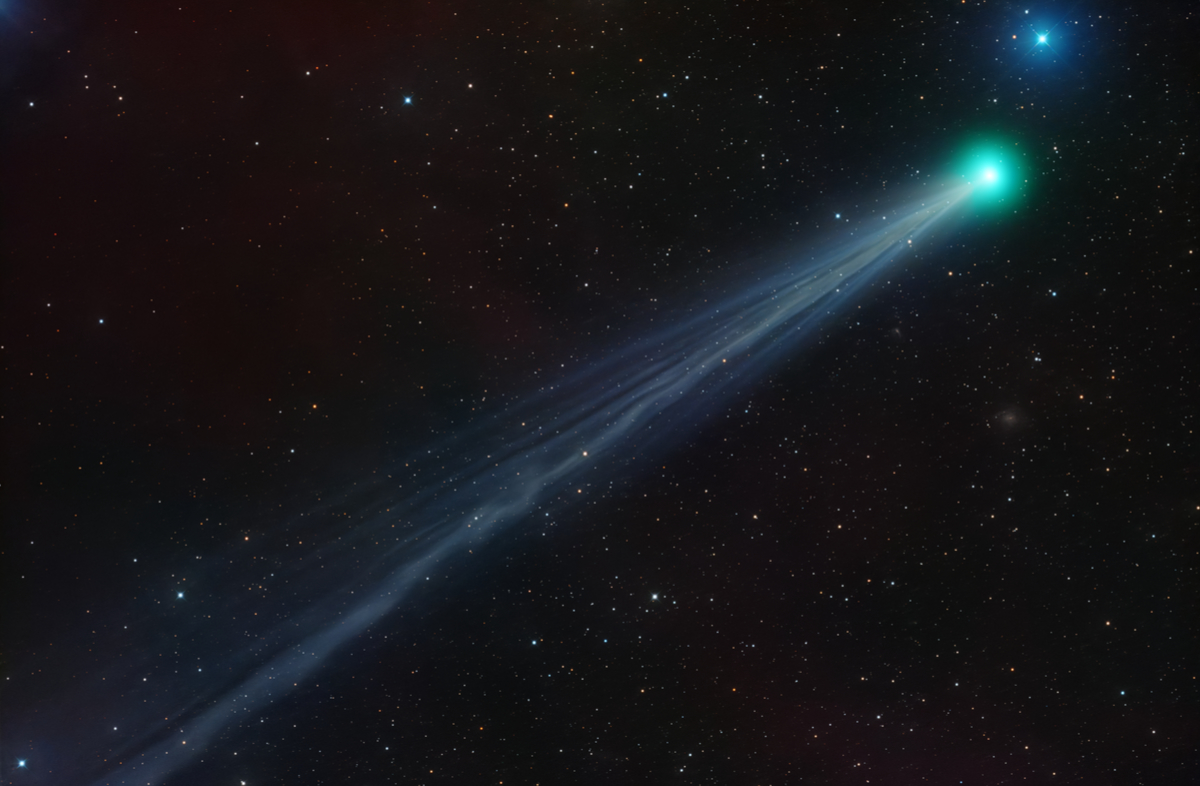
Comet C/2025 R3 (PanSTARRS) was discovered in images obtained on September 9th 2025 by the Panoramic Survey Telescope and Rapid Response System (PanSTARRS) in Hawaii. It passed perihelion on April 19th 2026 at a distance of approximately 0.5 AU from the Sun. Shortly thereafter, in early May 2026, the comet became visible to the naked eye with an apparent magnitude of about 3, primarily from the Southern Hemisphere owing to its southern declination.
Prior to its passage through the inner Solar System, the comet’s orbital eccentricity was only slightly below 1, corresponding to a highly elongated periodic orbit with an estimated orbital period of roughly 170,000 years. Gravitational perturbations within the inner Solar System subsequently increased the eccentricity to greater than 1, placing the comet on a hyperbolic trajectory. Unless it experiences further perturbations, it will therefore escape the Solar System permanently.
The image was acquired on May 10th 2026. From the LRGB exposures obtained over a period of approximately one hour, stacked luminance frames with individual exposure times of 240 s were generated at multiple time intervals. These were combined with a master RGB stack (300 s in each color channel) to produce time-resolved LRGB images separated by intervals of approximately 2.5 minutes. This processing makes it possible to study the pronounced dynamical structure within the comet’s tail. The “still frame” corresponds to the midpoint of the imaging session, at approximately 17:57 UT, with an effective temporal resolution of 13 minutes, corresponding to the interval during which sixteen 15 s luminance exposures were recorded in an L L L R G B sequence.


Bemerkungen:

Der Komet C/2025 R3 (PanSTARRS) wurde auf Bildern vom 9. September 2025 des Panoramic Survey Telescope and Rapid Response System (PanSTARRS) in Hawaii entdeckt. Er durchlief sein Perihel am 19. April 2026 in etwa 0.5 AU Abstand von der Sonne. Kurz danach (Anfang Mai 2026) wurde er mit einer scheinbaren Helligkeit von ca. 3 mag sogar visuell sichtbar, wegen südlicher Deklination vor allem auf der Südhalbkugel.
Die Exzentrizität der Bahn lag vor der Annäherung an die Sonne bei nur knapp unter 1, was einer periodischen Bahn mit Umlaufzeiten von geschätzt 170000 Jahren entsprach. Durch Bahnstörungen im inneren Sonnensystem hat sich die Exzentrizität auf über 1 erhöht, so dass sich der Komet nun auf einer hyperbolischen Bahn befindet und damit das Sonnensystem verlassen wird, sofern er nicht andere Störungen erfährt.
Die Aufnahme wurde am 10. Mai 2026 gemacht. Aus den LRGB-Belichtungen über einen Zeitraum von ungefähr einer Stunde entstanden gestackte Einzelbilder mit einer Belichtungszeit von 240 s in Luminanz an vielen Zeitpunkten. Diese wurden mit einem Gesamtstack von RGB (jeweils 300 s pro Farbkanalkanal) zu zeitaufgelösten LRGB-Bildern im Abstand von etwa 2.5 Minuten verrechnet. So kann die hohe Dynamik im Schweif beobachtet werden. Das „Standbild“ entspricht der Mitte der Aufnahme-Session, also ungefähr 17:57 UT mit einer zeitlichen Auflösung von 13 Minuten, entsprechend des Zeitraumes in dem 16 mal 15 s Luminanz-Belichtungen im L L L R G B-Zyklus stattfanden.

Back to the Comet Overview / Zurück zur Kometen-Übersichtsseite