[back]
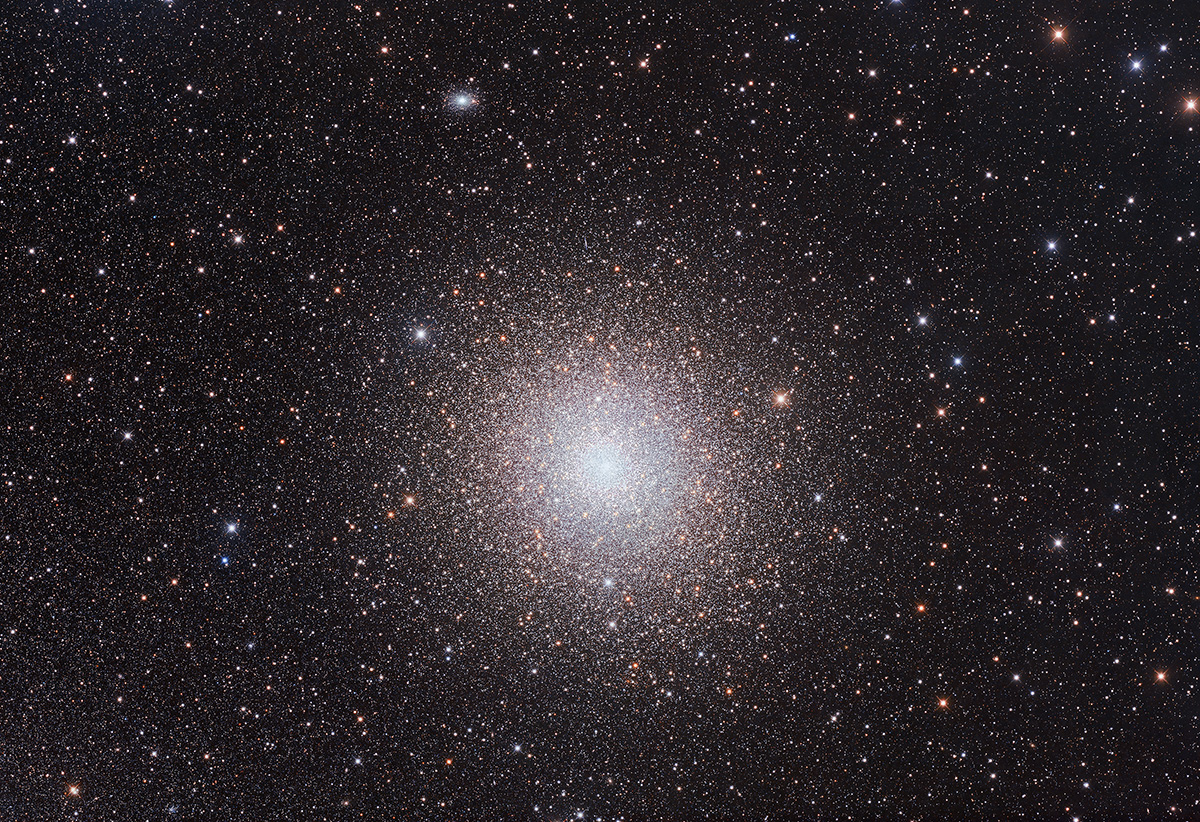
NGC 104 (47 Tucanae) in Tucana
[NED]
Bigger
image version / Größere Bild-Version (6000 x 4112
pixel)
|
(c) 2026 All astro photo images are copyrighted. They may not be used or reproduced without explicit written permission from the authors. |
|
300" |
|
About this Image / Über dieses Bild
| Camera: | Moravian C3-PRO-61000 Mono CMOS |
| Image Type, Orientation: | L-RGB Color Composite, North is at 12:00 |
| Exposure time: | L: 85x120s, R: 56x120s, G: 52x120s, B: 53x120s (04:06h total) |
| Exposure date: | October 11th...November 23rd, 2025 |
| Location: | Capella Observatory South at Kiripotib Astro Farm, Namibia |
| Filter: | Astronomik Deep-Sky Deep-Sky RGB Filter on Moravian EFW-3L-9-II External Filter Wheel |
| Instrument: | "Rhea", a PlaneWave DeltaRho 350, 1050mm focal length, 350mm aperture, f/3 on 10Micron GM2000 HPS II Combi |
| Photographer: | Rainer Raupach, Stefan Binnewies, Frank Sackenheim, Josef Pöpsel |
| Remarks: |
NGC 104 (47 Tucanae) is the second-brightest and
second-largest globular cluster visible from Earth. In terms of these
values, only Ω Centauri outshines it. Its angular diameter is 32′ and its
visual magnitude is 5.8 mag. It is located in the southern sky in the
constellation Tucana, at a declination of nearly -72° and in close proximity
to the Small Magellanic Cloud (SMC). The name 47 Tucanae reveals that,
despite its prominence, this cluster was first cataloged as the 47th star in
Tucana before being included in Nicholas Louis de Lacaille’s catalog of
“Southern nebulous objects” in 1751. NGC 104 has a diameter of 120 light-years, is located 13,400 light-years away, and is moving toward us at a speed of just under 20 km/s. Despite its celestial proximity to the Small Magellanic Cloud, it is not dynamically connected to it; this satellite galaxy of the Milky Way is 210,000 light-years away. We would also like to draw your attention to the small globular cluster NGC 121, located to the left and above NGC 104. This cluster actually belongs to the Small Magellanic Cloud (SMC) and is one of the most elongated “globular” clusters in the sky. This image thus contains more superlatives than one might initially think. Text excerpted in part from the “Atlas der Sternhaufen und Nebel“ by Michael König and Stefan Binnewies (KOSMOS Verlag) |
|
|
|
| Bemerkungen: |
Bei NGC 104 (47 Tucanae) handelt
es sich um den zweithellsten und zweitgrößten Kugelsternhaufen, den wir von
der Erde aus beobachten können. Bezogen auf diese Werte stiehlt ihm nur Ω
Centauri die Show. Sein Winkeldurchmesser beträgt 32‘ und seine visuelle
Helligkeit liegt bei 5,8 mag. Er steht am Südhimmel im Sternbild Tukan, bei
einer Deklination von fast -72° und in direkter Nachbarschaft zur kleinen
Magellanschen Wolke (SMC). Der Name 47 Tucanae verrät, dass dieser Haufen,
trotz der Prominenz, zuerst als 47. Tukan-Stern katalogisiert wurde, bevor
er dann 1751 von Nicholas Louis de Lacaille in den Katalog der „Southern
nebulous objects“ aufgenommen wurde. Text in Teilen aus dem Bildatlas der Sternhaufen und Nebel v. Michael König u. Stefan Binnewies (KOSMOS Verlag) |
Back to the Globular Clusters Overview / Zurück zur Kugelsternhaufen-Übersichtsseite