|
Remarks: |
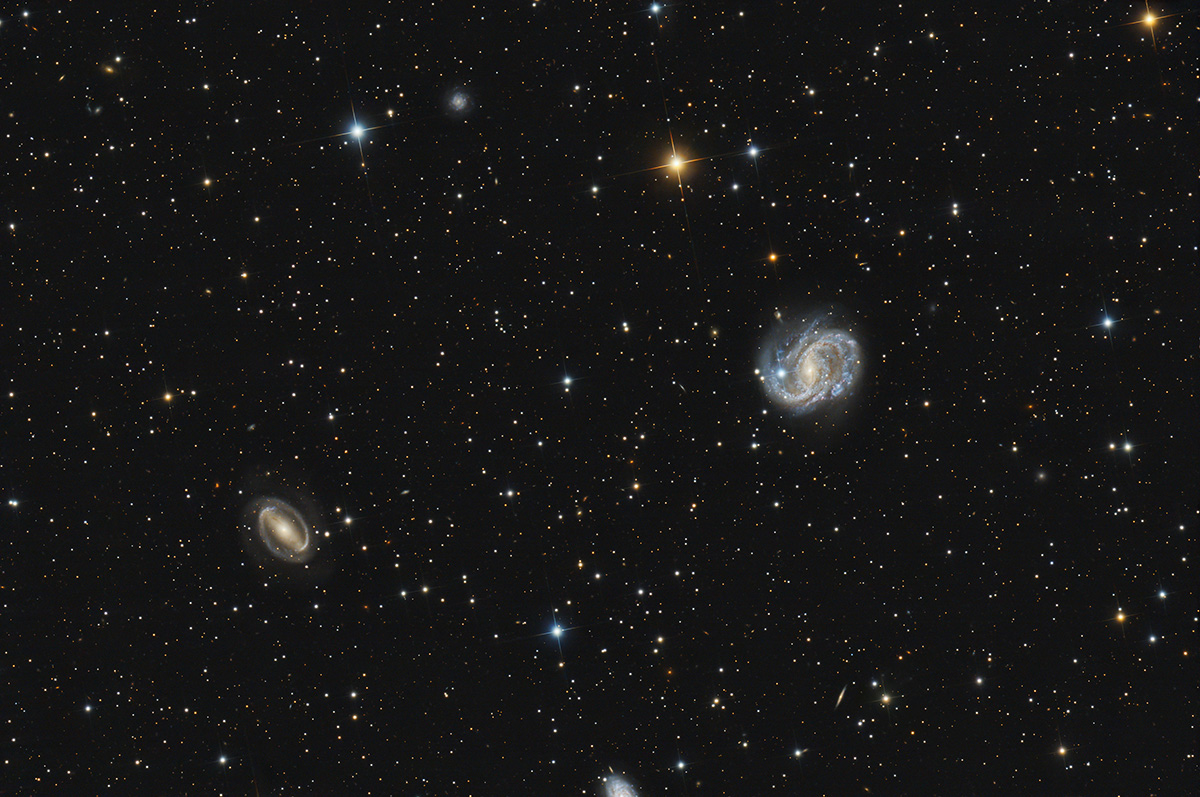
NGC 6956 is a barred spiral galaxy
in the constellation Delphinus. Like so many other objects, it was
discovered by William Herschel in 1784 — a remarkable feat considering how
small the galaxy appears in the sky.
NGC 6956 belongs to a small galaxy group designated KTG 71 or LGG 440. The
group also includes UGC 11620 (unfortunately cut off at the bottom of the
frame) and UGC 11623 to the east of NGC 6956. The galaxies are physically
associated but show no signs of gravitational interaction.
The best-known image of the galaxy comes from the Hubble Space Telescope,
which observed NGC 6956 as part of a campaign to calibrate the cosmic
distance ladder. Distances to extragalactic objects are among the hardest
quantities to determine in astronomy. Astronomers work around this using
standard candles: objects whose true luminosity is known, allowing their
distance to be derived from their apparent brightness. Cepheids are variable
stars whose pulsation period is directly related to their luminosity — but
they can only be resolved individually in relatively nearby galaxies. Type
Ia supernovae reach much further, but they need to be calibrated themselves.
That is exactly what makes galaxies like NGC 6956 so valuable: here, both
methods can be tied directly to one another. The well-documented SN 2013fa
in NGC 6956 made this possible — contributing to the determination of the
Hubble constant, the expansion rate of the universe.
In amateur telescopes NGC 6956 appears tiny, and images of this galaxy are
correspondingly rare. We were able to capture this image with the new
1-metre mirror of the Skinakas Observatory during the telescope's testing
phase. Many thanks to the team at Skinakas Observatory! |
|
Bemerkungen: |
NGC 6956 ist eine Balkenspiralgalaxie im Sternbild
Delphin. Entdeckt wurde sie – wie so viele andere Objekte – 1784 von Wilhelm
Herschel. Eine bemerkenswerte Leistung, wenn man sich anschaut, wie klein
die Galaxie am Himmel erscheint.
NGC 6956 gehört zu einer kleinen Galaxiengruppe, die als KTG 71 bzw. LGG 440
bezeichnet wird. Dazu zählen außerdem UGC 11620 (unten im Bild leider
angeschnitten) und UGC 11623 östlich von NGC 6956. Die Galaxien gehören
physisch zusammen, zeigen aber keine Anzeichen einer gravitativen
Wechselwirkung.
Die wohl bekannteste Aufnahme der Galaxie stammt vom
Hubble-Weltraumteleskop, das NGC 6956 im Rahmen einer Messreihe zur
Kalibrierung der sogenannten kosmischen Entfernungsleiter beobachtet hat.
Entfernungen zu extragalaktischen Objekten gehören zu den am schwersten zu
bestimmenden Größen der Astronomie. Man behilft sich mit Standardkerzen:
Objekten, deren wahre Leuchtkraft man kennt und die man deshalb über ihre
scheinbare Helligkeit als Entfernungsmarke nutzen kann. Cepheiden sind
veränderliche Sterne, deren Pulsationsperiode direkt mit ihrer Leuchtkraft
zusammenhängt – sie lassen sich aber nur in vergleichsweise nahen Galaxien
einzeln auflösen. Typ-Ia-Supernovae reichen sehr viel weiter, müssen dafür
aber selbst geeicht werden. Genau deshalb sind Galaxien wie NGC 6956 so
wertvoll: Hier lassen sich beide Methoden direkt aneinander anschließen. Die
gut dokumentierte SN 2013fa in NGC 6956 machte das möglich – und damit einen
Beitrag zur Bestimmung der Hubble-Konstante, also der Expansionsrate des
Universums.
In Amateurteleskopen wirkt NGC 6956 winzig – entsprechend selten sind
Aufnahmen dieser Galaxie. Mit dem neuen 1-m-Spiegel des
Skinakas-Observatoriums durften wir während der Testphase des Teleskops
dieses Bild erstellen. Herzlichen Dank an das Team des
Skinakas-Observatoriums! |