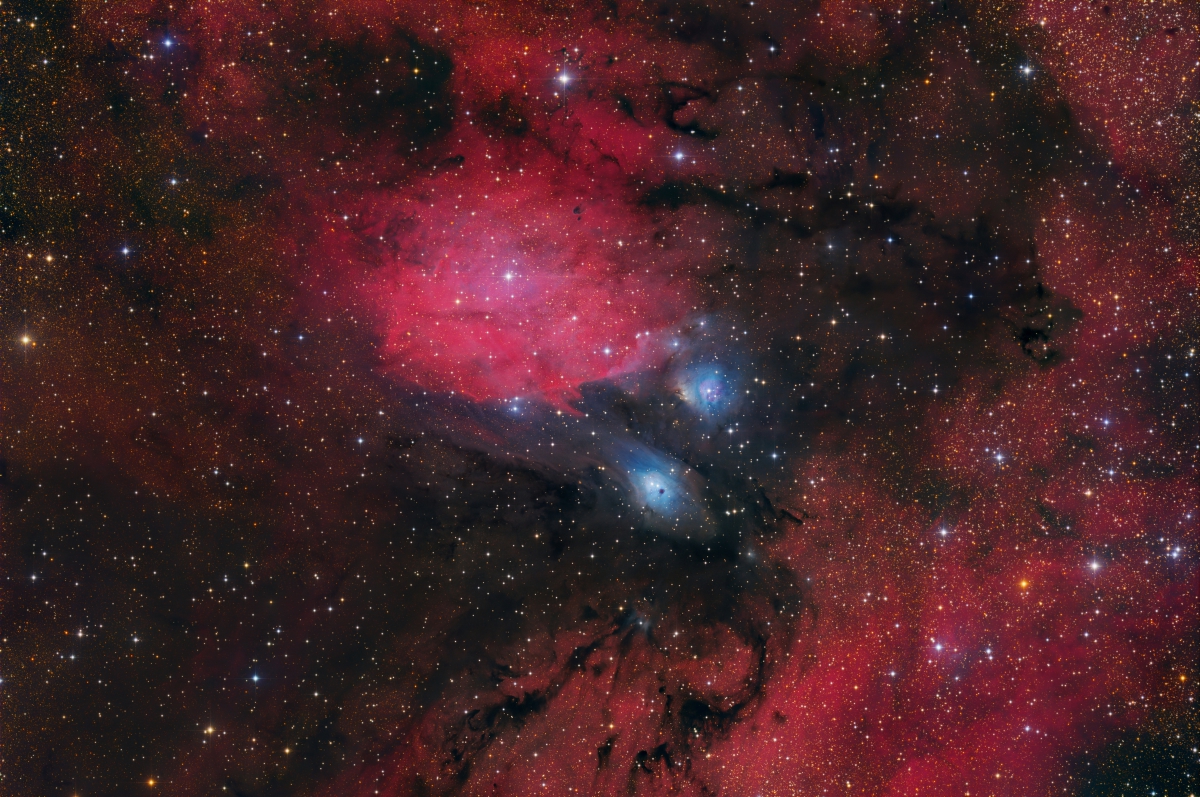
[back] Sh2-73 / IC 1284 in Sagittarius [NED]

Big, 100% image version / Große, 100% Bild-Version (6007 x 3992 pixel)
Annotated version / Beschriftete Version (6007 x 3992 pixel)

 (c) 2026 All astro photo images are copyrighted. They may not be used or reproduced without explicit written permission from the authors.


300"


About this Image / Über dieses Bild

CCD: Omegon veTEC410c
Image Type, Orientation: RGB-HaOIII Composite, North is at 12:00h
Exposure time: RGB: 64x300s, HaOIII: 51x300s  (9:35 total)
Exposure date:

July 5th..11th 2024

Location: Capella Observatory at Skinakas, Crete/Greece,robotic (with babysitting from Bad Arolsen/Germany)
Filter: RGB: Internal Bayer-Matrix, HA/OIII:  STC Astro Duo-Narrowband Filter
Instrument: Ganymed 60cm-Hypergraph in primary focus (f=1840 mm)

Final Image Seeing (FWHM):

2.3"

Photographer: Josef Pöpsel, Frank Sackenheim, Stefan Binnewies
   

Remarks:

The nebulae shown here lie a good one degree south of the Small Sagittarius Star Cloud, M24. Even within our team there was some confusion about what this object — or rather these objects — are actually called, because there are numerous catalogue entries. We could not even agree on the nicknames: one of us spoke of the Strawberry in Sagittarius, the other of the Raspberry. The most fitting catalogue designation for the red glowing gas nebula is Sh2-37, or IC 1284. The southern of the two blue reflection nebulae is known under no fewer than three entries: NGC 6595, NGC 6590 and IC 4700. The more northern reflection nebula also has two catalogue entries, NGC 6589 and IC 4690. The whole tangle of discoveries and catalogue designations has been carefully researched on Deep Sky Corner.
The gas nebula IC 1284 itself was discovered photographically by E. E. Barnard in 1892. The later catalogue entry goes back to Stewart Sharpless, who identified the nebula in 1959 on plates of the Palomar Observatory Sky Survey — hence the designation Sh2-37. An interesting question is which of the stars visible in the field excites the red gas nebula to glow. To the best of our knowledge, it is HD 167815, the brightest and central star within the red glowing nebula, a multiple system of spectral type B1/2 III.
While processing this image, we ran into a surprise: after continuum subtraction of the Hα data, a small, well-defined, bubble-like emission structure appeared around HD 167638 — right in the middle of the reflection nebula NGC 6589 — which was not visible in the broadband filters. This is exactly the structure that astrophotographer Josep Drudis described in 2020: a bubble of about 27 arcseconds in radius, discovered in deep Hα exposures from 2019 and subsequently recovered in the archival data of the SuperCOSMOS Hα Survey. Drudis published the finding as a Research Note dof the American Astronomical Society (RNAAS 4, 18, 2020) — a moderated, but not peer-reviewed format. Unfortunately, no professional follow-up study exists to date, and the nature of the bubble therefore remains unexplained. What this little Hα bubble actually is, nobody currently knows. But the fact that it shows up reproducibly in independently acquired and independently processed amateur data demonstrates one thing: it is real, not an artifact.


Bemerkungen:

Gut ein Grad südlich der Kleinen Sagittarius-Wolke M24 liegen die hier gezeigten Nebel. Bereits innerhalb unseres Teams kam es zu Missverständnissen darüber, wie dieses Objekt bzw. diese Objekte nun eigentlich heißen, denn es gibt zahlreiche Katalogeinträge. Und nicht einmal bei den Trivialnamen waren wir uns einig: Der eine sprach von der Erdbeere im Sagittarius, der andere von der Himbeere. Die wohl treffendste Katalogbezeichnung für den rot leuchtenden Gasnebel ist Sh2-37 oder IC 1284. Der südliche der beiden blauen Reflexionsnebel ist gleich unter drei Einträgen bekannt: NGC 6595, NGC 6590 und IC 4700. Auch der nördlichere der Reflexionsnebel hat zwei Katalogeinträge, NGC 6589 sowie IC 4690. Das ganze Entdeckungs- und Katalogdurcheinander ist auf der Seite Deep Sky Corner sauber recherchiert.
Der eigentliche Gasnebel IC 1284 wurde 1892 von E. E. Barnard fotografisch entdeckt. Der spätere Katalogeintrag geht auf Stewart Sharpless zurück, der den Nebel 1959 auf den Platten des Palomar Observatory Sky Survey fand — daher die Bezeichnung Sh2-37. Interessant ist nun, welcher der im Feld sichtbaren Sterne den roten Gasnebel zum Leuchten anregt. Nach unserem Kenntnisstand ist das HD 167815, der hellste und zentrale Stern im rot leuchtenden Gasnebel, ein Mehrfachsystem vom Spektraltyp B1/2 III.
Bei der Bearbeitung dieser Aufnahme kam eine Überraschung: Nach der Kontinuumsubtraktion der Hα-Daten erschien um HD 167638 — mitten im Reflexionsnebel NGC 6589 — eine kleine, wohldefinierte, blasenförmige Emissionsstruktur, die nicht in den Breitbandfiltern sichtbar war. Genau diese Struktur hat der Astrofotograf Josep Drudis 2020 beschrieben: eine Blase von etwa 27 Bogensekunden Radius, entdeckt in tiefen Hα-Aufnahmen von 2019 und anschließend in den Archivdaten des SuperCOSMOS-Hα-Surveys wiedergefunden. Drudis publizierte den Fund als Research Note der American Astronomical Society (RNAAS 4, 18, 2020) — ein moderiertes, aber nicht peer-reviewtes Format. Eine professionelle Nachuntersuchung existiert bislang aber leider nicht, und auch die Natur der Blase bleibt damit ungeklärt. Was diese kleine Hα-Blase also ist, weiß derzeit niemand. Dass sie in unabhängig aufgenommenen und unabhängig bearbeiteten Amateurdaten reproduzierbar auftaucht, zeigt immerhin: Sie ist real, kein Artefakt.

Back to the Diffuse Nebulae Overview / Zurück zur Diffuse-Nebel-Übersichtsseite