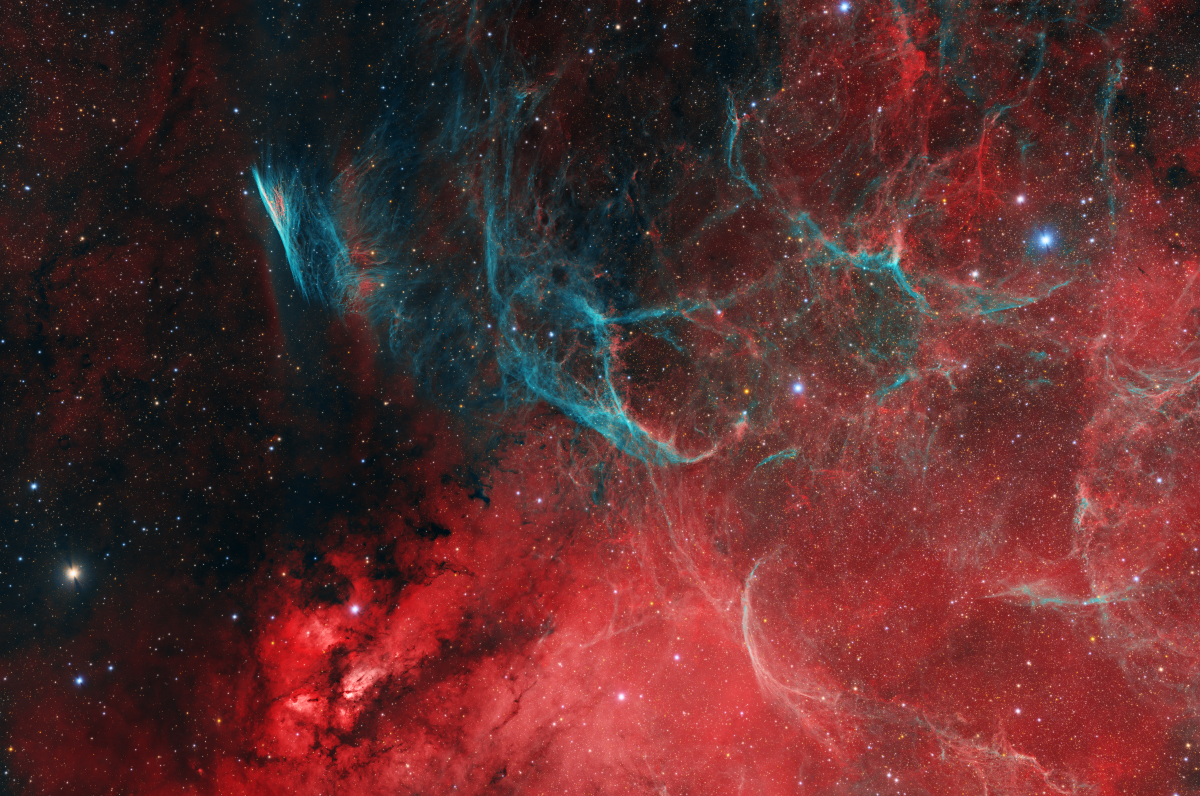
[back] NGC 2736 (Pencil Nebula) and friends in Vela [NED]
Big,
100% image version / Große, 100% Bild-Version (9458 x 6273
pixel)
Annotated version / Beschriftete Version (9458 x 6273
pixel)
|
(c) 2026 All astro photo images are copyrighted. They may not be used or reproduced without explicit written permission from the authors. |
|
0.5 degree |
|
About this Image / Über dieses Bild
| Camera: | Moravian C3-PRO-61000 Mono CMOS |
| Image Type, Orientation: | Ha OIII Near Real Color Composite, North is at 12:00 |
| Exposure time: | Ha: 114 x 300s, OIII: 115*300s (19:05h total) |
| Exposure date: | March/April 2024 |
| Location: | Capella Observatory South at Kiripotib Astro Farm, Namibia |
| Filter: | Astronomik Deep-Sky 6nm Ha, OIII filters on Moravian EFW-3L-9-II External Filter Wheel |
| Instrument: | "Callisto", a Takahashi FSQ 106N, 530mm focal length, 106mm aperture, f/5 on modified Losmandy G11 (high res encoders with OnStepX) |
| Photographer: | Rainer Raupach, Frank Sackenheim, Josef Pöpsel |
| Remarks: |
For those of us in the northern hemisphere, spring is the
season without a Milky Way: the band of the winter Milky Way dips below the
horizon in the constellation Canis Major. Travel to the southern hemisphere,
though, and you'll find that this is where things really begin – beyond
Canis Major, in the constellations Puppis and Vela, lies one of the most
fascinating regions of our galaxy. This is home to one of the largest nebula regions in the entire sky: the Gum Nebula, a predominantly red-glowing emission structure spanning some 36 degrees. Embedded within it stretches another object of enormous size, the Vela supernova remnant with its predominantly blue filaments. Our image captures only a small section of both – and its most striking feature is the Pencil Nebula, NGC 2736. This filamentary nebula is not an object in its own right, but part of the Vela supernova remnant. Here, the remnant's shock wave has presumably slammed into a denser region of the interstellar medium, producing the nebula's striking, fan-like structure. An alternative interpretation attributes the shape to hot gas from a second, younger supernova remnant – Vela Junior – colliding with the dense hydrogen wall of the old remnant (Redman et al. 2002). Below the Pencil Nebula lies Gum 22, the brightest core of the star-forming region RCW 38. Unlike the Pencil Nebula, this region is not part of the Vela complex: at around 5,500 light-years, it sits far in the background. The two brightest stars in the image frame the scene in depth: at lower left, c Velorum, an orange giant of spectral class K2III that, at roughly 300 light-years, lies well in front of the supernova remnant – and at upper right, a Velorum, an A-type giant some 1,500 light-years away, far behind it. One peculiarity only reveals itself at second glance: a bluish veil hugging the left side of the Pencil Nebula, which further east gives way abruptly to a red glow. What looks like an image artifact is real – and it reveals the anatomy of a shock front. Immediately behind the front, freshly shocked gas glows in the blue-green light of ionized oxygen, while the red hydrogen only lights up further downstream, in the cooling zone. That sharp color transition marks nothing less than the front of the blast wave itself. |
|
|
|
| Bemerkungen: |
Für uns auf der Nordhalbkugel ist das Frühjahr die
Jahreszeit ohne Milchstraße: Das Band der Wintermilchstraße taucht im
Sternbild Großer Hund (Canis Major) unter den Horizont. Wer jedoch auf die
Südhalbkugel reist, sieht, dass es dort erst richtig losgeht – jenseits des
Großen Hundes erstreckt sich in den Sternbildern Puppis und Vela eine der
spannendsten Regionen der Milchstraße. |
Back to the Diffuse Nebulae Overview / Zurück zur Diffuse-Nebel-Übersichtsseite