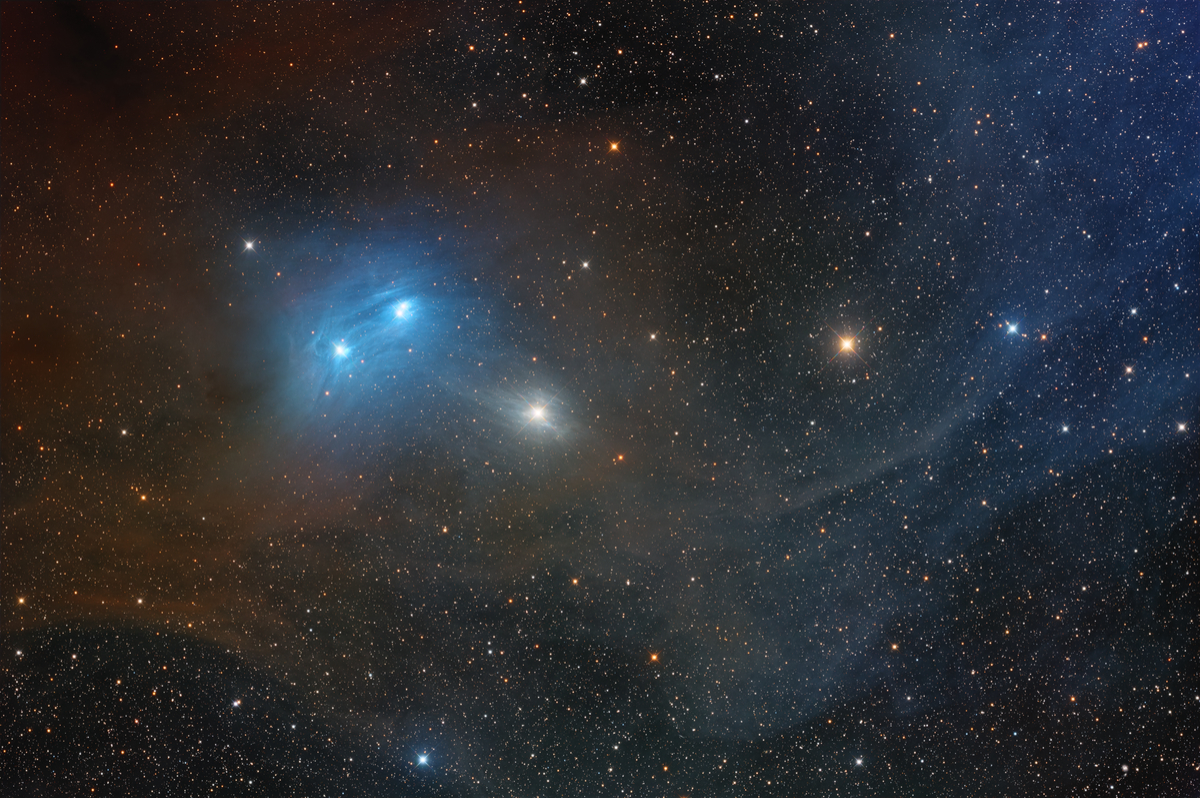
[back] IC 4601 in Scorpius
Annotated version / Beschriftete Version
|
(c) 2026 All astro photo images are copyrighted. They may not be used or reproduced without explicit written permission from the authors. |
|
300" |
|
About this Image / Über dieses Bild
| Camera: | Moravian C3-PRO-61000 Mono CMOS |
| Image Type, Orientation: | LRGB-Ha Composite, North is at 12:00 |
| Exposure time: | L: 45 x 300 s, RGB: 32/32/32 x 300 (11:45h total) |
| Exposure date: | April 20thth...May, 13th, 2026 |
| Location: | Capella Observatory South at Kiripotib Astro Farm, Namibia |
| Filter: | Astronomik Deep-Sky Deep-Sky RGB Filter on Moravian EFW-3L-9-II External Filter Wheel |
| Instrument: | "Rhea", a PlaneWave DeltaRho 350, 1050mm focal length, 350mm aperture, f/3 on 10Micron GM2000 HPS II Combi |
| Photographer: | Rainer Raupach, Stefan Binnewies, Josef Pöpsel, Frank Sackenheim |
| Remarks: |
IC 4601 is a reflection nebula located within the
constellation Scorpius, illuminated by several bluish B-type stars. The
nebula is also cataloged as Bernes 156, and is subdivided into two primary
centers designated as Cederblad (Ced) 129b and Ced 129c. The adjacent
K0III-type star HIP 79945 is responsible for an additional reflection
nebula, Ced 129a. The interstellar medium reflecting this stellar radiation
is a component of the Ophiuchus molecular cloud complex, which constitutes
one of the nearest active star-forming regions to Earth at a distance of
approximately 400 to 460 light-years. In addition to numerous reflection nebulae, this region contains dark nebulae that obscure the light from background stars. Several of these features are listed in the Magnani, Blitz, and Mundy (MBM) catalog. Unlike catalogs based strictly on optical opacity—such as the Barnard catalog—the MBM catalog focuses on high-galactic-latitude clouds and the presence of carbon monoxide (CO) detected via radio emissions. The presence of CO serves as a tracer for low kinetic temperatures, which is a prerequisite for star formation since interstellar matter can only undergo gravitational collapse under cold conditions. Furthermore, many of these high-latitude objects are not completely opaque at optical wavelengths but are instead characterized as translucent clouds. |
|
|
|
| Bemerkungen: |
IC 4601 ist ein Reflexionsnebel
im Sternbild Skorpion, der durch mehrere bläuliche B-Sterne erzeugt wird.
Der Nebel wird außerdem als Bernes 156 geführt, und bezogen auf die zwei
Zentren in Cederblad (Ced) 129b und 129c unterteilt. Der benachbarte
K0III-Stern HIP 79945 ist für einen weiteren Reflexionsnebel Ced 129a
verantwortlich. Die interstellare Materie, die das Licht der Sterne
reflektiert, ist Teil der Ophiuchus-Molekülwolke, eine mit 400 bis 460
Lichtjahren Entfernung uns am nächsten gelegenen Sternentstehungsregion. |
Back to the Diffuse Nebulae Overview / Zurück zur Diffuse-Nebel-Übersichtsseite