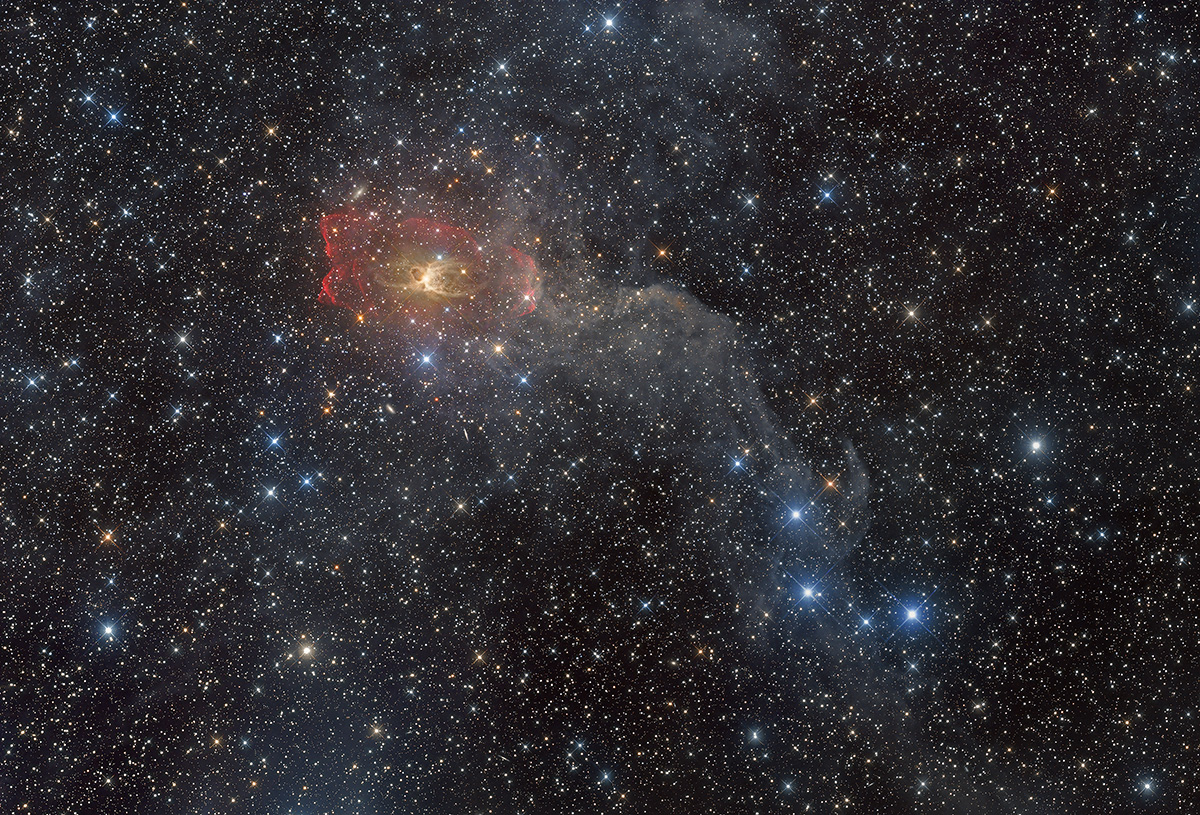
[back] IC2220 (Toby Jug Nebula) in Carina [NED]
Bigger image version / Größere Bild-Version (5000
x 3395
pixel)
Annotated version / Beschriftete Version (5000
x 3395
pixel)
|
(c) 2026 All astro photo images are copyrighted. They may not be used or reproduced without explicit written permission from the authors. |
|
300" |
|
About this Image / Über dieses Bild
| Camera: | Moravian C3-PRO-61000 Mono CMOS |
| Image Type, Orientation: | L-RGB-Ha Color Composite, North is at 12:00 |
| Exposure time: | L: 27x300s, R: 18x300s, G: 18x300s, B: 18x300s, Ha: 22x900s (12:15h total) |
| Exposure date: | April 24th...May 24th 2026 |
| Location: | Capella Observatory South at Kiripotib Astro Farm, Namibia |
| Filter: | Astronomik Deep-Sky LRGB and 6nm Ha filters on Moravian EFW-3L-9-II External Filter Wheel |
| Instrument: | "Rhea", a PlaneWave DeltaRho 350, 1050mm focal length, 350mm aperture, f/3 on 10Micron GM2000 HPS II Combi |
| Photographer: | Rainer Raupach, Stefan Binnewies, Josef Pöpsel, Frank Sackenheim |
| Remarks: |
The nicknames given to objects in the Anglo-American
astronomy community are sometimes difficult to translate into German. The
reflection nebula IC 2220 is also referred to as the “Toby Jug Nebula,”
which is even its official name in SIMBAD. If you look it up, you’ll find
that it refers to a ceramic jug depicting a caricature of a pipe-smoking man
wearing a tricorn hat. The English word “tobacconist” is reflected in “Toby”
and traces back to the character Toby Belch in William Shakespeare’s comedy
*Twelfth Night*. Whether one can actually see all these shapes in the nebula is doubtful. However, one can make out yellow-glowing dust arcs and, further out, the red-glowing arc segments—discovered as recently as 2018 by Josep Drudis et al.—that extend over 20 arcminutes in an east-west direction. Overall, this results in a bipolar structure centered on the star V341 Carina (HD65750). V341 Carina is a 6.3-magnitude M1II-type star, i.e., a bright giant star. The star is classified as a long-period variable, though its period is unknown. Slow, irregular fluctuations in its brightness are observed. Over a period of 5 years, its brightness rises or falls by about 0.5 mag; rarely, dimming events occur that reach the same amplitude over several months. The distance to V341 Carina is 1,419 ± 32 light-years. The star’s surface is approximately 3,700 K and glows orange. This stellar color is also responsible for the color of the reflection nebula; the corresponding values are the B-V color index = 2.02 mag and the Gaia color index GBP-GRP = 2.53 mag. V341 Carina is an evolved giant star currently in its AGB phase. The star’s radius is approximately 120 solar radii, and its luminosity is 2,500 solar luminosities. The star’s current mass is 2.2 solar masses, while the nebula contains a mass of 1 solar mass. The clouds of smoke that can still be seen today thus fit well with the image of the pipe smoker mentioned at the beginning. Text from the “Bildatlas der Sternhaufen und Nebel“ by Michael König and Stefan Binnewies (KOSMOS Verlag) |
|
|
|
| Bemerkungen: |
Die Spitznamen, die man in der angloamerikanischen
Astroszene Objekten gibt, sind mitunter schwer ins Deutsche zu übersetzen.
Beim Reflexionsnebel IC2220 liest man auch vom „Toby-Jug-Nebula“, der sogar
im SIMBAD offiziell so benannt wird. Schaut man nach, so stößt man auf die
Bezeichnung eines Kruges aus Keramik, der die Karikatur eines Pfeife
rauchenden Mannes mit einem Dreispitz zeigt. Das englische „tobacconist“
findet sich in „Toby“ wieder und geht auf die Figur Toby Belch in der
Komödie „Was ihr wollt“ von William Shakespeare zurück. |
Back to the Diffuse Nebulae Overview / Zurück zur Diffuse-Nebel-Übersichtsseite