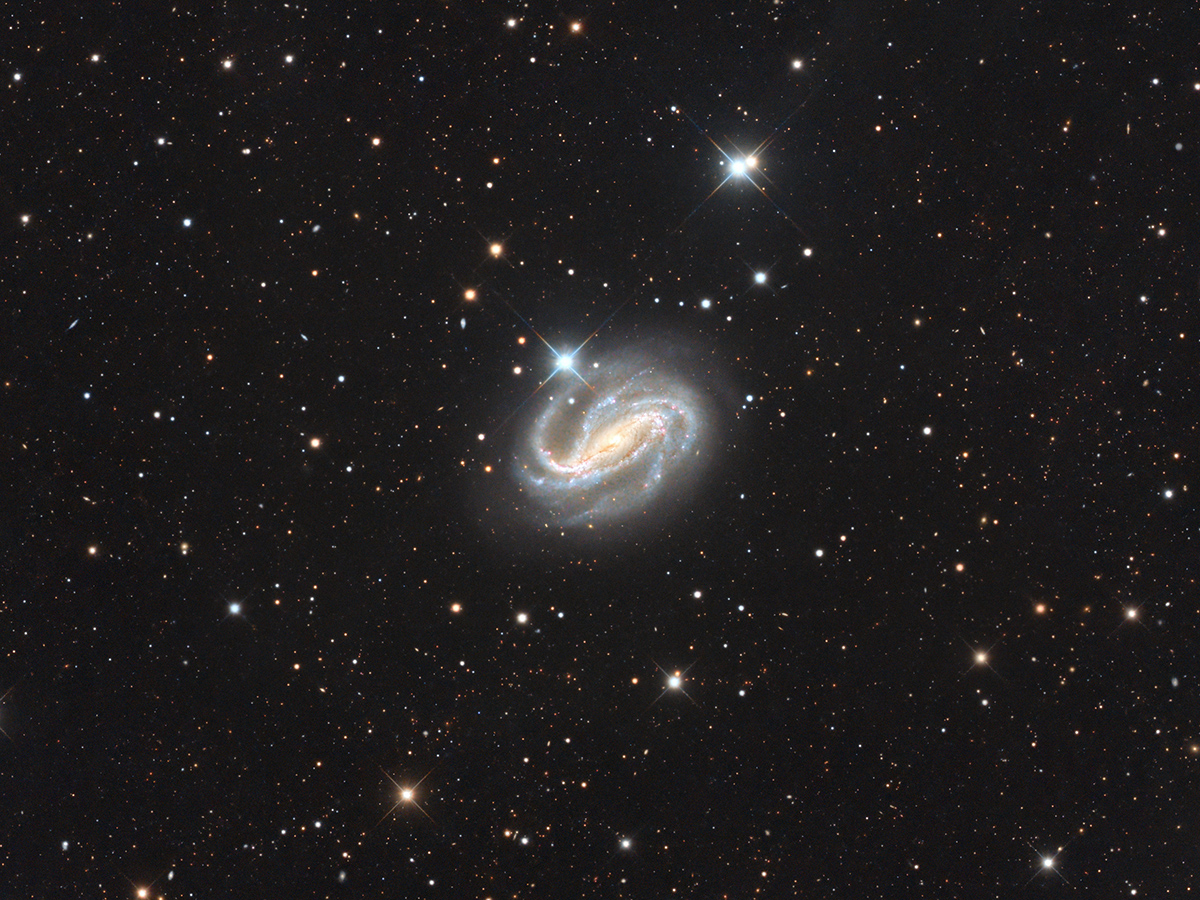
[back] NGC 613 in Sculptor [NED]
Higher resolved image / höher aufgelöstes LRGB-Bild (4500 x 3098 Pixel)
Higher resolved center image / höher aufgelöstes LRGB-Bild des Zentrums (2480 x 1860)
Cropped Center
|
Type SBbc, distance ~ 25Mpc/80MLy |
|
300"' |
|
(c) 2025 All astro photo images are copyrighted. They may not be used or reproduced without explicit written permission from the authors.
.
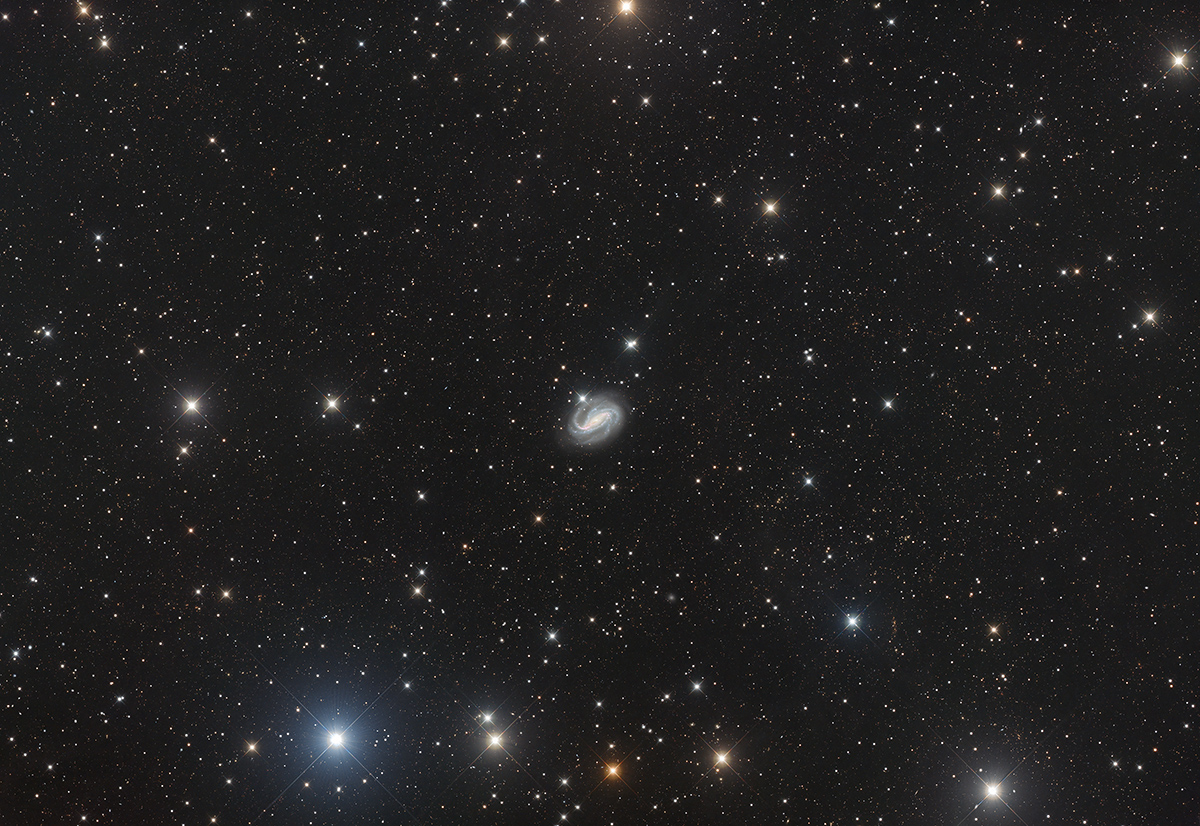
Complete field
|
Type SBbc, distance ~ 25Mpc/80MLy |
|
(c) 2025 All astro photo images are copyrighted. They may not be used or reproduced without explicit written permission from the authors
About this Image / Über dieses Bild
| Camera: | Moravian C3-PRO-61000 Mono CMOS |
| Image Type, Orientation: | LRGB-Ha Composite, North is at 12:00 |
| Exposure time: | L: 52x300s, R: 41x300s, G: 39x300s, B: 44x300s, Ha: 16x900s (18:40h total) |
| Exposure date: | August 21st...October 15st, 2025 |
| Location: | Capella Observatory South at Kiripotib Astro Farm, Namibia |
| Filter: | Astronomik Deep-Sky Deep-Sky RGB Filter plus 6nm HaI filter on Moravian EFW-3L-9-II External Filter Wheel |
| Instrument: | "Rhea", a PlaneWave DeltaRho 350, 1050mm focal length, 350mm aperture, f/3 on 10Micron GM2000 HPS II Combi |
| Photographer: | Rainer Raupach, Stefan Binnewies, Josef Pöpsel, Frank Sackenheim |
| Remarks: |
The
SB(rs)bc galaxy NGC 613 is 65 million light-years away from the Milky Way,
and its angular dimensions of 5.5 x 4.2' give it a transverse disk diameter
of 100,000 light-years. The structure of NGC 613 is dominated by a broad,
3.1' long bar interspersed with dust lanes. The dust signatures are more
pronounced in the lower, southeastern half of the bar. Along the bar, an
offset of the dust lanes can be seen at the center, which harbors an active
galactic nucleus. At the end of the bar, two spiral arms begin, which have
many active regions in the transition zone. The spiral pattern in NGC 613 is
not uniform, and the tight structure of the inner arms forms an oval ring
that encloses the bar. A secondary focus image of NGC 613 done with Ganymed more than 20 years before the one above can be found here. |
|
|
|
| Bemerkungen: |
Die SB(rs)bc-Galaxie NGC 613 ist 65
Millionen Lichtjahre von der Milchstrasse entfernt und die Winkelgrößen von
5,5 x 4,2' liefern einen transversalen Scheibendurchmesser von 100.000
Lichtjahren. Der Aufbau von NGC 613 wird durch einen breiten und 3,1' langen
Balken bestimmt, der von Staubbändern durchzogen wird. In der unteren,
südöstlichen Balkenhälfte sind die Staubsignaturen deutlicher ausgeprägt. Im
Verlauf des Balkens erkennt man am Ort des Zentrums, das einen aktiven
Galaxienkern beherbergt, einen Versatz der Staubbänder. Am Ende des Balkens
setzen zwei Spiralarme an, die in der Übergangszone viele aktive Regionen
besitzen. Das Spiralmuster in NGC 613 ist nicht gleichförmig aufgebaut, und
die enge Struktur der inneren Arme formt einen ovalen Ring, der den Balken
umschließt. |
Back to the Galaxies' Overview / Zurück zur Galaxien-Übersichtsseite