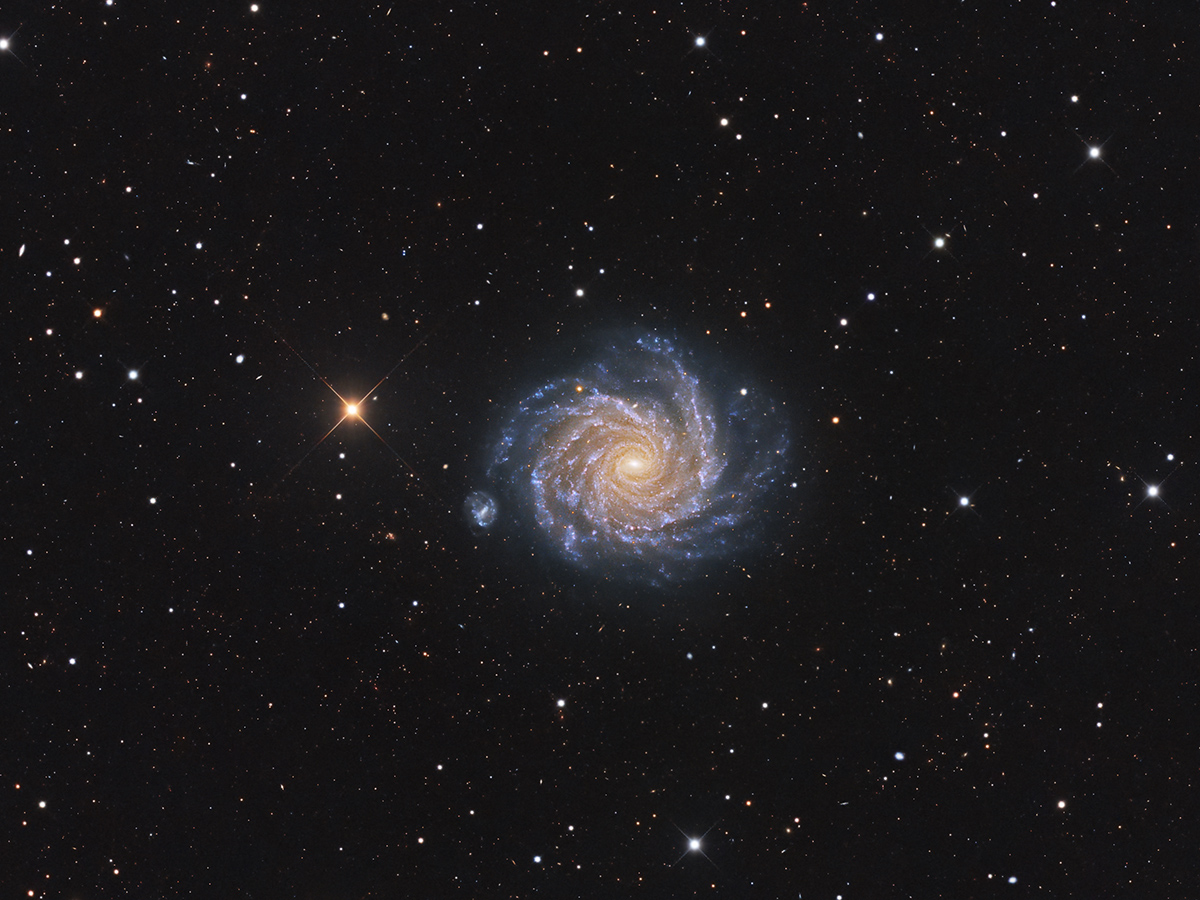
[back] NGC 1232 in Eridanus [NED]
Higher resolved image / höher aufgelöstes LRGB-Bild (6000 x 3986 Pixel)
Higher resolved center image / höher aufgelöstes LRGB-Bild des Zentrums (2480 x 1860 Pixel)
Cropped Center
|
Type SBc, distance ~ 15Mpc/50MLy |
|
300"' |
|
(c) 2025 All astro photo images are copyrighted. They may not be used or reproduced without explicit written permission from the authors.
.
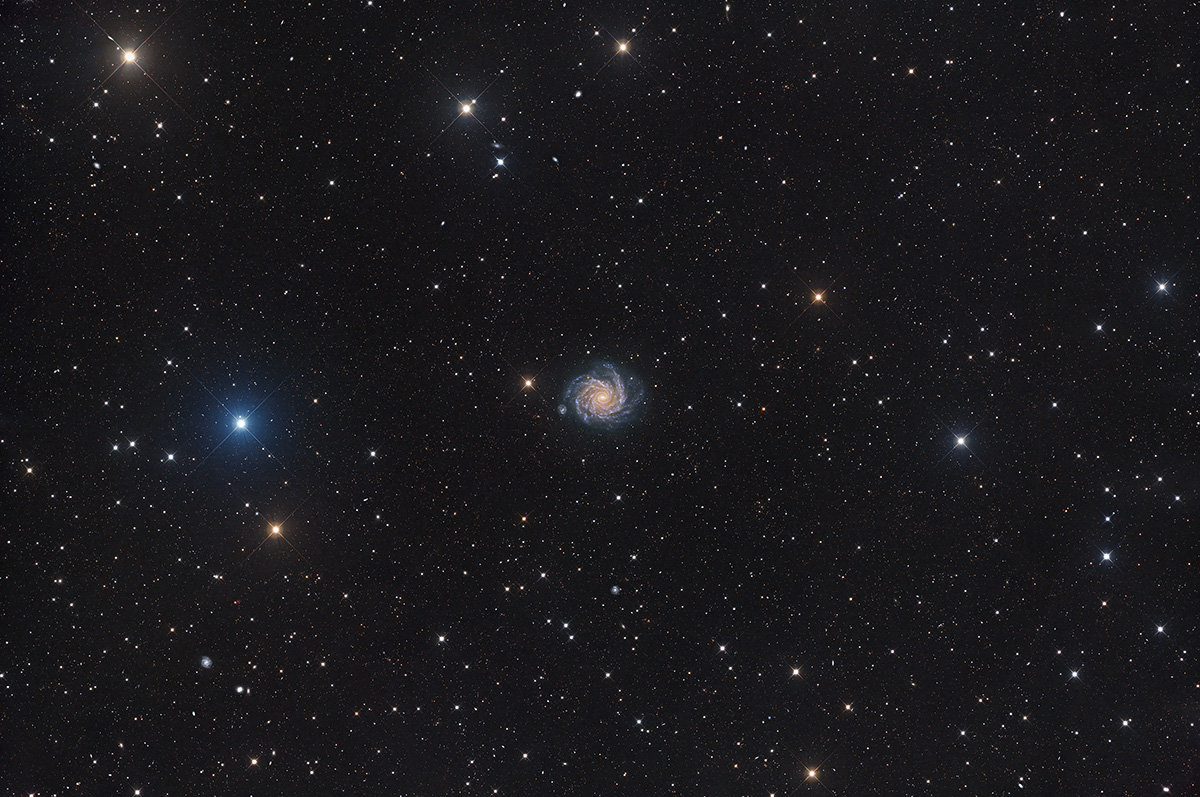
Complete field
|
Type SBc, distance ~ 15Mpc/50MLy |
|
(c) 2025 All astro photo images are copyrighted. They may not be used or reproduced without explicit written permission from the authors
About this Image / Über dieses Bild
| Camera: | Moravian C3-PRO-61000 Mono CMOS |
| Image Type, Orientation: | LRGB Composite, North is at 12:00 |
| Exposure time: | L: 74x300s, R: 41x300s, G: 40x300s, B: 40x300s (16:15h total) |
| Exposure date: | September 14th...October 19tht, 2025 |
| Location: | Capella Observatory South at Kiripotib Astro Farm, Namibia |
| Filter: | Astronomik Deep-Sky Deep-Sky LRGB Filter on Moravian EFW-3L-9-II External Filter Wheel |
| Instrument: | "Rhea", a PlaneWave DeltaRho 350, 1050mm focal length, 350mm aperture, f/3 on 10Micron GM2000 HPS II Combi |
| Photographer: | Rainer Raupach, Stefan Binnewies, Josef Pöpsel, Frank Sackenheim |
| Remarks: |
NGC
1232 The SAB(rs)c galaxy NGC 1232 is 68 million light-years away from the
Milky Way. The dimensions of this grand design galaxy are 7.4′ × 6.5′,
resulting in a projected disk diameter of 146,000 light-years. The bright
center of NGC 1232 is compact and part of a short, faint bar that is
oriented horizontally in the image. Along the bar axis, however, the center
is elongated, and in the surrounding yellow-glowing bulge there are several
dust lanes leading to the beginnings of the spiral arms. The spiral pattern
in NGC 1232 is defined by several arms, which do not form a flocculent
pattern, but can be traced almost a full revolution to the edge of the disk.
The numerous HII regions in the spiral arms are markers for
Woronzow-Weljaminow series, whose 120° kinks and increase in series length
are particularly easy to see due to the direct view of the disk plane. At
the left edge of the galaxy, 4′ to the east, the galaxy NGC 1232A (PGC
011834) can be seen at a distance of 4′ to the east. Since the escape
velocity of this SB galaxy is 6599 km/s, which is above the value of 1603
km/s for NGC 1232, interaction is unlikely due to the high relative
velocity. The angular size of 0.9′ and the distance of 290 million
light-years derived from the escape velocity result in a typical disk
diameter of 75,000 light-years for NGC 1232A. Observations with the Chandra
X-Ray Observatory (NASA) revealed a peculiarity in the X-ray emission at NGC
1232. The data show a diffuse, comet-shaped emission cloud. Its center of
brightness does not coincide with the center of NGC 1232, but is located
14,000 light-years away in the southern half of the disk. In the image, this
location is below the center of NGC 1232, but there is no optical
counterpart. The X-rays are produced by thermal emission from gas in the
cloud heated to 6 × 10⁶ K, whose total mass is estimated at several hundred
solar masses. Astronomers suspect that the cloud is the remnant of a dwarf
galaxy that crashed into NGC 1232 and was destroyed in the process. As the
halo passed through NGC 1232, the gas heated up due to a shock front,
leaving behind this striking signature. Since the spiral structure of the
galaxy remained undisturbed, a large proportion of dark matter in NGC 1232
is likely. |
|
|
|
| Bemerkungen: |
NGC 1232 Die SAB(rs)c-Galaxie NGC 1232 ist
68 Millionen Lichtjahre von der Milchstraße entfernt. Die Ausmaße dieser
„grand design“-Galaxie betragen 7,4′ × 6,5′ und ergeben einen projizierten
Scheibendurchmesser von 146.000 Lichtjahren. Das helle Zentrum von NGC 1232
ist kompakt und Teil eines kurzen, schwach ausgeprägten Balkens, der in der
Aufnahme waagerecht orientiert ist. Entlang der Balkenachse ist das Zentrum
jedoch gestreckt und im umgebenden, gelb leuchtenden Bulge finden sich
einige Staubbänder, die zu den Ansätzen der Spiralarme führen. Das
Spiralmuster in NGC 1232 wird durch mehrere Arme bestimmt, die jedoch kein
flokkulentes Muster ausbilden, sondern sich fast über einen ganzen Umlauf
bis zum Scheibenrand verfolgen lassen. Die zahlreichen HII-Regionen in den
Spiralarmen sind Marker für Woronzow-Weljaminow-Reihen, deren 120°-Knicke
sowie Zunahme der Reihenlänge durch den direkten Einblick auf die
Scheibenebene besonders gut zu erkennen sind. Am linken Rand der Galaxie
erkennt man in 4′ Abstand in östlicher Richtung die Galaxie NGC 1232A (PGC
011834). Da die Fluchtgeschwindigkeit dieser SB-Galaxie mit 6599 km/s über
dem Wert von 1603 km/s für NGC 1232 liegt, ist aufgrund der hohen
Relativgeschwindigkeit eine Wechselwirkung unwahrscheinlich. Aus der
Winkelgröße von 0,9′ ergibt sich mit der aus der Fluchtgeschwindigkeit
abgeleiteten Entfernung von 290 Millionen Lichtjahren ein typischer
Scheibendurchmesser von 75.000 Lichtjahren für NGC 1232A. Beobachtungen mit
dem Chandra X-Ray Observatory (NASA) offenbarten bei NGC 1232 eine
Besonderheit der Röntgenemission. Die Daten zeigen eine diffuse,
kometenartig geformte Emissionswolke. Deren Helligkeitszentrum fällt nicht
mit dem Zentrum von NGC 1232 zusammen, sondern liegt 14.000 Lichtjahre davon
entfernt in der südlichen Scheibenhälfte. In der Aufnahme liegt dieser Ort
unterhalb des Zentrums von NGC 1232, es findet sich jedoch kein optisches
Gegenstück. Die Röntgenstrahlung entsteht durch thermische Emission von 6 ×
106 K heißem Gas der Wolke, deren Gesamtmasse auf einige 100 Sonnenmassen
abgeschätzt wird. Astronomen vermuten, dass es sich bei der Wolke um die
Reste einer Zwerggalaxie handelt, die in NGC 1232 hineingestürzt ist und
dabei zerstört wurde. Bei der Passage des Halos in NGC 1232 heizte sich das
Gas durch eine Stoßfront auf und hinterließ diese auffällige Signatur. Da
die Spiralstruktur der Galaxie dennoch ungestört blieb, ist ein großer
Anteil Dunkler Materie in NGC 1232 wahrscheinlich. |
Back to the Galaxies' Overview / Zurück zur Galaxien-Übersichtsseite