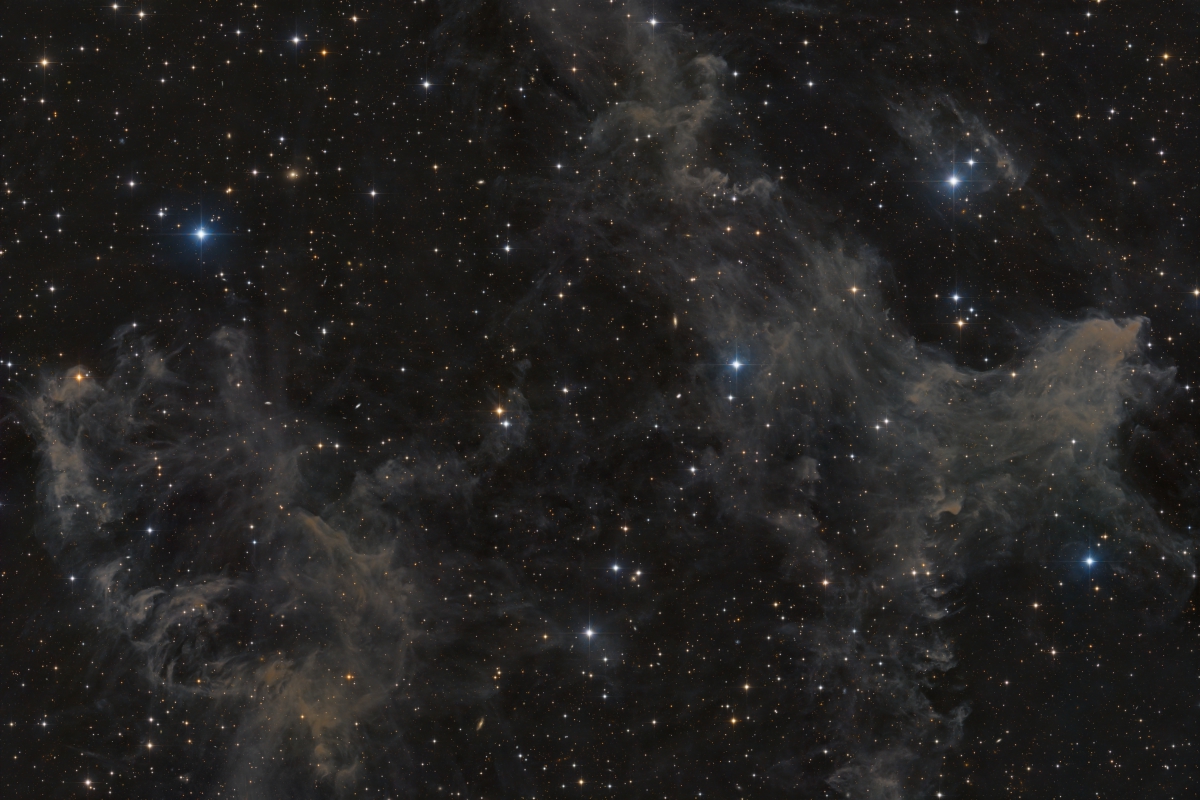
[back] MBM 56 (Flying Poodle Nebula, part of LBN 470) in Pegasus
100% version (6041 x 4026 Pixel)
Anotated version
|
(c) 2025 All astro photo images are copyrighted. They may not be used or reproduced without explicit written permission from the authors. |
|
300" |
|
About this Image / Über dieses Bild
| CCD: | Omegon veTEC410c |
| Image Type, Orientation: | RGB, North is at 12:00h |
| Exposure time: | RGB: 118x300s (9:50 total) |
| Exposure date: |
August 28th... September 5th 2024 |
| Location: | Capella Observatory at Skinakas, Crete/Greece, remote-controlled from Ireland during a Van trip |
| Filter: | RGB: Internal Bayer-Matrix |
| Instrument: | Ganymed 60cm-Hypergraph in primary focus (f=1840 mm) |
| Photographer: | Josef Pöpsel, Frank Sackenheim, Stefan Binnewies |
|
Remarks: |
In the direction of the constellation Pegasus there is an extreme amount of dust, so-called galactic cirrus. Our image shows a condensation of these dust clouds near the star 67 Pegasi (just outside the field of view). This condensation carries the informal name “Flying Poodle Nebula”, although we have not been able to trace who originally coined this title.The catalogue designations are also a bit confusing. The most likely matching entry is MBM 56. In the mid-1980s, Magnani, Blitz and Mundy carried out a survey in the CO band to detect molecular gas at high galactic latitudes (i.e. far away from the Milky Way’s disk). What we see in our image, however, is only the optical component of this catalogue entry.Already on the plates of the Palomar Observatory Sky Survey (POSS), these molecular clouds were visible as very faint brightenings, which Beverly Lynds catalogued as LBN 470, assuming it to be an H II region. To this day, this misconception has not been corrected, and thus this molecular cloud is still incorrectly listed as an H II region in the SIMBAD database. |
|
Bemerkungen: |
In Richtung des Sternbildes Pegasus befindet sich extrem viel Staub, sogenannter galaktischer Zirrus. Unsere Aufnahme zeigt eine Verdichtung dieser Staubwolken in der Nähe des Sterns 67 Pegasi (außerhalb des Gesichtsfeldes). Diese Verdichtung trägt den Trivialnamen „Flying Poodle Nebula“, wobei wir nicht nachvollziehen konnten, wer für diesen Titel verantwortlich ist. Auch die Katalogbezeichnungen sind ein wenig verwirrend. Der vermutlich zutreffendste Eintrag ist MBM 56. Magnani, Blitz und Mundy haben Mitte der 1980er Jahre einen Survey im CO-Band durchgeführt, um molekulares Gas in hohen galaktischen Breiten (also weit weg von der Milchstraßenebene) zu detektieren. Was wir auf unserer Aufnahme sehen, ist allerdings lediglich die optische Komponente dieses Katalogeintrags. Bereits auf den Platten des Palomar Observatory Sky Survey (POSS) waren diese Molekülwolken als sehr schwache Aufhellungen zu erkennen, die Beverly Lynds in ihrem Katalog als LBN 470 katalogisiert hat, in der Annahme, es würde sich um eine HII-Region handeln. Bis heute ist dieser Irrtum nicht korrigiert, und so ist diese Molekülwolke in der SIMBAD-Datenbank immer noch fälschlich als HII-Region gelistet. |
Back to the Diffuse Nebulae Overview / Zurück zur Diffuse-Nebel-Übersichtsseite